Reliable local evidence
FoL focuses matching on discriminative regions instead of treating every patch as equally useful.
AAAI 2025 Conference Paper
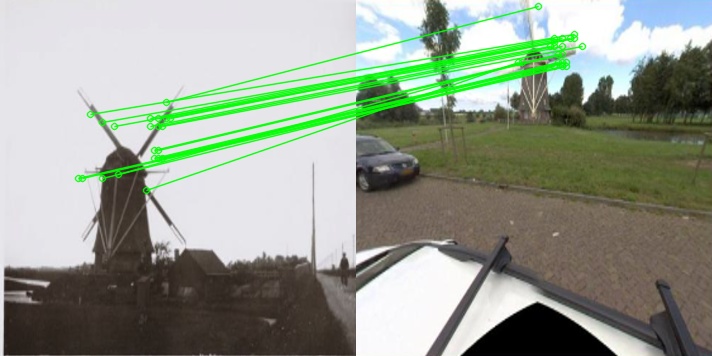
FoL is a two-stage Visual Place Recognition (VPR) approach that improves image retrieval and re-ranking by focusing on reliable, discriminative local regions.
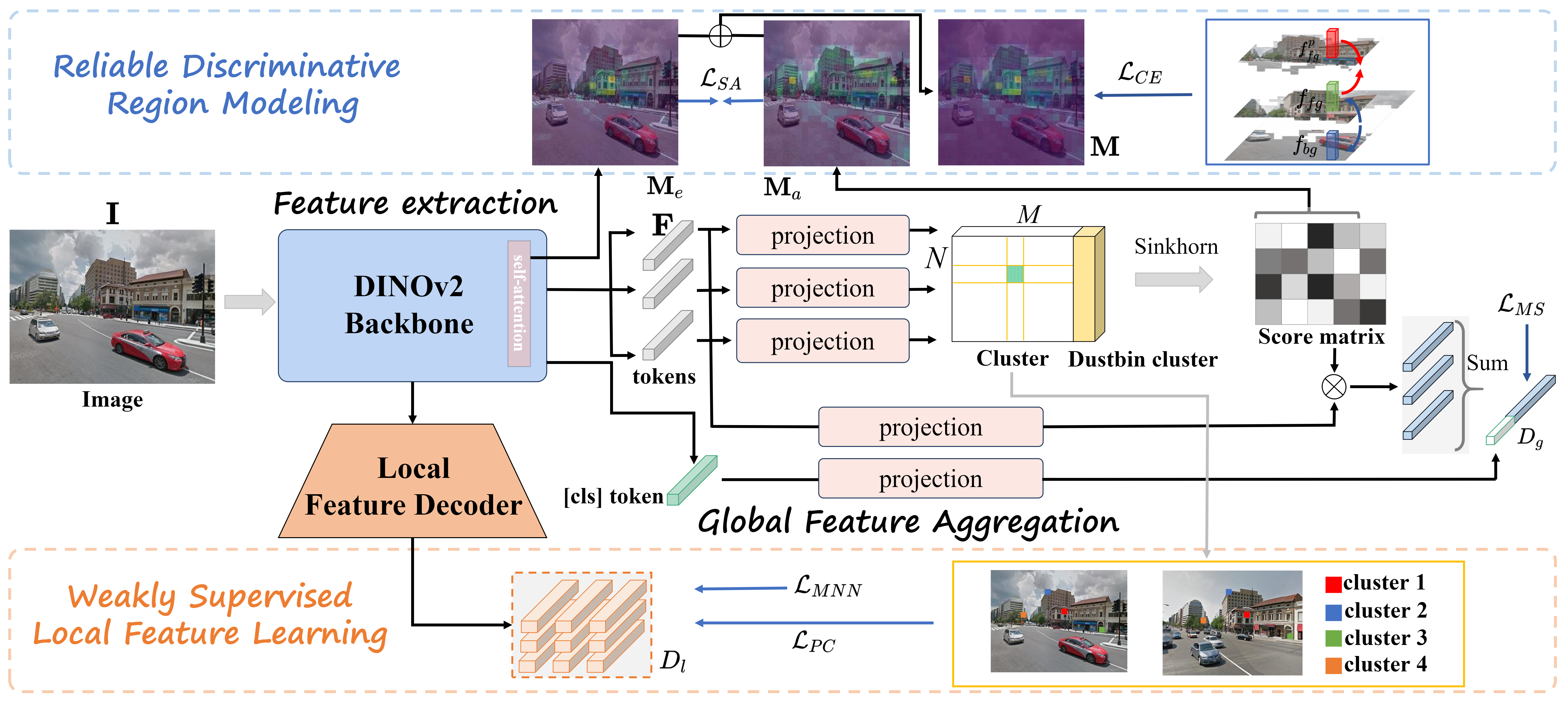
FoL studies how to identify reliable discriminative regions for VPR, where not every local patch is equally useful under viewpoint, illumination, and seasonal changes. Instead of relying only on whole-image similarity, FoL first retrieves candidate places globally and then selects stable, informative local regions to support fine-grained re-ranking, making the final match decision more robust in visually ambiguous scenes.
FoL focuses matching on discriminative regions instead of treating every patch as equally useful.
Global retrieval supplies efficient candidates, while local re-ranking improves precision for hard cases.
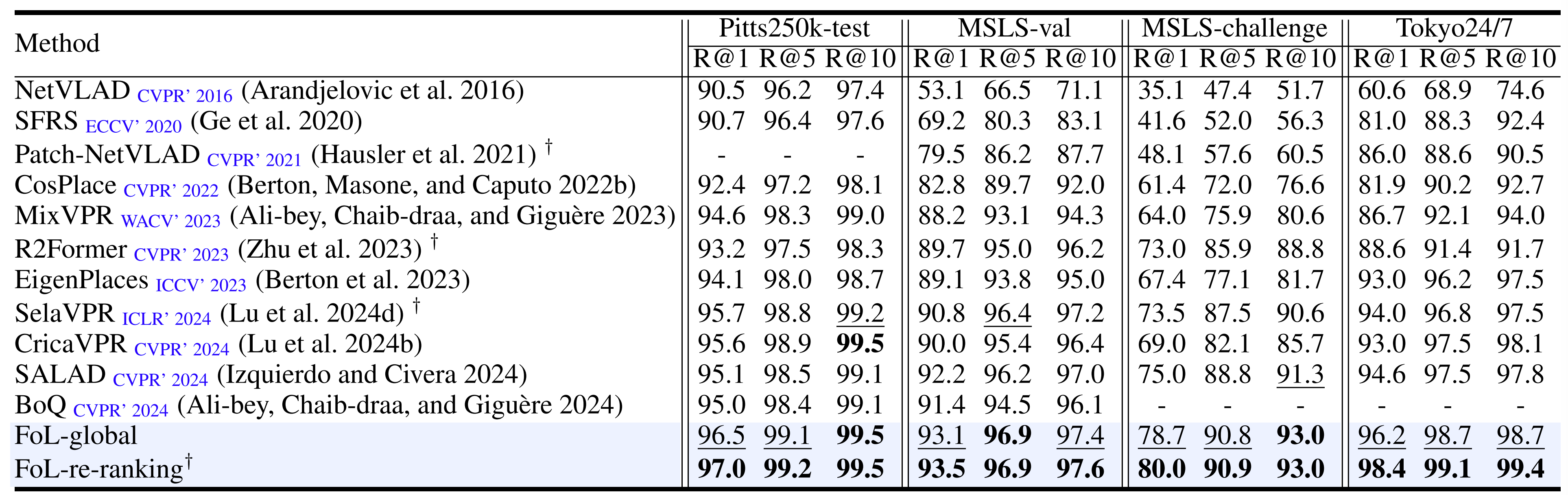
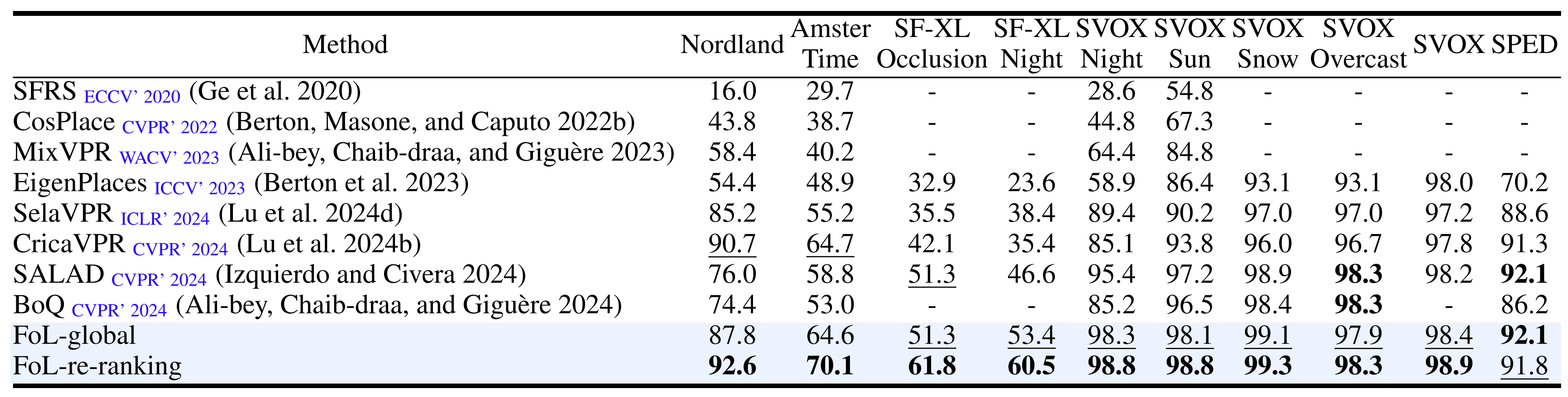
Experiments report Recall@K on common VPR datasets including Pitts, MSLS, Tokyo24/7, Nordland, SF-XL, SVOX, and Eynsham.
The repository includes training, evaluation, pretrained weights, Torch Hub loading, and visualization scripts.
FoL uses a DINOv2-based visual backbone and aggregation module to produce compact image descriptors for first-stage retrieval.
The model searches for stable, informative local regions that are more likely to support true place correspondence.
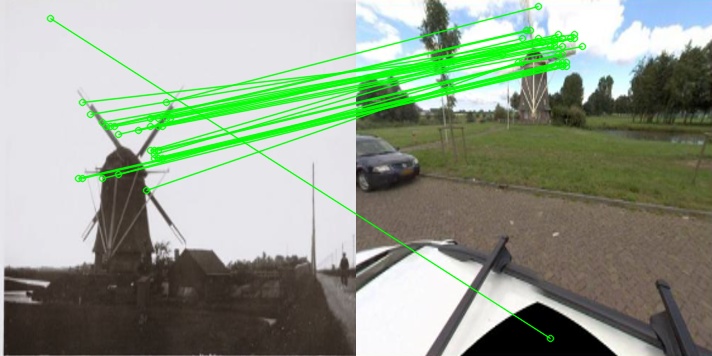
Candidate matches are refined with region-aware local evidence, improving robustness in visually ambiguous or condition-shifted scenes.
FoL is evaluated against representative VPR methods on standard benchmarks. The results emphasize the benefit of local re-ranking, especially on challenging condition-shifted datasets.
For questions, contact: shunpengchen@bupt.edu.cn
@inproceedings{FoL,
  title={Focus on Local: Finding Reliable Discriminative Regions for Visual Place Recognition},
  author={Wang, Changwei and Chen, Shunpeng and Song, Yukun and Xu, Rongtao and Zhang, Zherui and Zhang, Jiguang and Yang, Haoran and Zhang, Yu and Fu, Kexue and Du, Shide and others},
  booktitle={Proceedings of the AAAI Conference on Artificial Intelligence},
  volume={39},
  number={7},
  pages={7536--7544},
  year={2025}
}